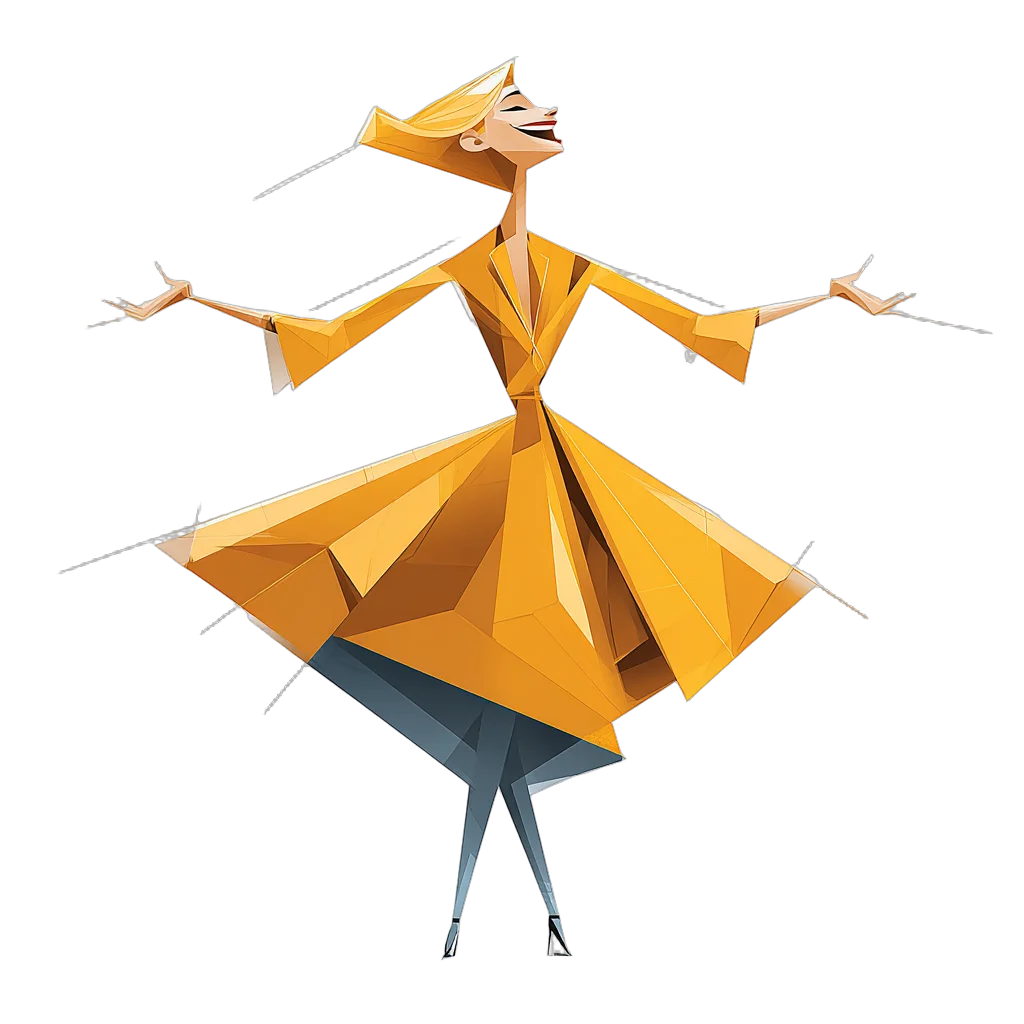
The Vivid Presence
You don't enter a room - you arrive in it, and the room knows.
"I am fully here, and I can also see what's coming."
- presence
- warmth
- spontaneity
- generosity
- immediacy
Who They Are
You're the person whose laugh someone remembers years later, even if they can't recall what was funny. There's a quality to how you inhabit space - fully, without the half-here distraction most people carry around like a phone in their pocket. When you're with someone, you're with them. When you taste something good, your face says so before your words do. This isn't performance, though people sometimes mistake it for that. It's just that the world reaches you unfiltered, and you respond in kind. You move through life by feel - not feeling in the soft sense, but feel as a craftsperson uses the word. The temperature of a room. The shift in someone's voice. The exact moment a party turns from polite to alive. You read these things without trying, and you act on them without rehearsal. Your generosity is reflexive: you'll give away the thing in your hand before you've decided whether you can spare it. The cost of living this close to the surface of experience is that the surface is where you live. The deeper currents - what something will mean in six months, where this pattern is heading, what you're slowly becoming - these run beneath your awareness until they break through, sometimes catastrophically. You're not shallow. You're the opposite of shallow in the moment. But the moment is your medium, and moments don't naturally string themselves into futures without help you don't always remember to ask for.
Cognitive Stack
Your engine runs on direct contact with the world - sights, sounds, textures, the live data of the present moment - and you process it faster than most people process a sentence. Underneath that, a private compass of values quietly checks every input against what feels right to you, which is why your warmth is real and your refusals, when they come, are immovable. Logic and structure are tools you reach for when you have to: you can organize, execute, and push things forward when the situation demands, but it's effortful rather than native. The weakest link is the long view - pattern-recognition over time, the slow inference about where things are headed. It surfaces as gut dread or sudden certainty, often too late to be useful, and you've learned to either ignore it or be unsettled by it.
Strengths
You're extraordinary in any situation that rewards presence over preparation. Crisis, performance, hospitality, working with people in distress, anything live - you're at your best when the script gets thrown out. You read rooms accurately and quickly. You remember the specific things about people that make them feel known: how they take their coffee, the name of their dog, what they were anxious about last time. Your generosity is genuine and unstrategic, which is rare enough that people occasionally don't know what to do with it. You can take a heavy moment and lighten it without trivializing it - a real skill, and one most people lack. And when you commit to someone or something, your loyalty is concrete rather than abstract: it shows up in actions, repeatedly, without needing recognition.
Blind Spots
Consequences. Not the obvious ones - you see those - but the ones that compound quietly over months. The credit card balance, the relationship that's been drifting, the health thing you keep meaning to check. You over-trust your ability to handle whatever lands, which is usually justified and occasionally catastrophic. You can confuse intensity for importance: the loudest current need crowds out the quieter, larger one. You sometimes commit to things in the warmth of a moment and find yourself trapped by the commitment when the moment has passed, and rather than renegotiate, you'll either over-deliver resentfully or vanish. You can also under-read people who hide their feelings well, because your radar is tuned to expression, not concealment.
In Love
You love generously and physically - touch, presence, doing things together rather than talking about doing things. You're not stingy with affection or attention, and a partner who needs reassurance will rarely lack it. You want a relationship that feels alive: shared meals, shared trips, shared jokes, the texture of a life together rather than a contract about one. Where it gets harder is the maintenance work that doesn't feel like anything in particular - the recurring conversations about money, the boring logistics of a long arc. You can also struggle when a partner needs you to sit with a problem rather than fix it or distract from it; your instinct is to lift the mood, and sometimes the mood needs to stay heavy for a while. When you feel truly unseen by a partner, you don't argue - you withdraw the warmth, and the absence of it is the message.
At Work
You're the person colleagues actually want to work with. You bring energy into meetings that would otherwise be funerals, and you're often the one who gets things unstuck by simply doing the next concrete thing while everyone else is still talking about it. Client-facing work, sales, teaching, anything performative or hands-on, anything requiring real-time judgment - these are your terrain. You execute well under pressure and you're usually unflappable in front of people, which is more uncommon than it sounds. The friction shows up in roles that demand sustained abstract planning, long solo focus, or rigorous documentation of work that's already done in your head. You'll resist process you find pointless, and you're often right that it's pointless, but you sometimes lose battles you could win by not framing them as battles. Recognition matters to you more than you usually admit - not status, but being actually seen for what you contributed. In environments where contribution is invisible, you wilt faster than most. You do your best work when you have autonomy over the how, a partner or team that handles the long-range planning, and feedback loops short enough that you can feel the impact of what you're doing.
Communication
You speak in stories, examples, and specifics - never in abstractions if you can help it. You're warm, often funny, and you read your audience as you go, adjusting in real time. You'd rather show than explain. You receive information best when it's concrete and ideally when there's a person attached to it; pure theory slides off you, not because you can't follow it but because you don't see why you should. You're not a fan of long preambles or careful hedging, and you tend to trust people who get to the point. Where you can struggle is hearing criticism that feels like it's about who you are rather than what you did - the distinction matters enormously to you, even when the speaker doesn't realize they've crossed it.
Under Stress
When the load gets too heavy, your usually-quiet long-range sense breaks loose and turns dark. You catastrophize - not loudly, but privately and with conviction. Suddenly everything is doomed, this is all going to fall apart, you've made some terrible mistake you can't yet identify. You may become uncharacteristically rigid, latching onto a single interpretation of events and defending it past the point of reason. Or you go the other way and bury the dread in stimulation: more drinks, more spending, more plans, more anything-but-this. Sleep gets bad. You'll either talk to no one about it or talk to everyone, neither of which actually helps. The way out is almost always slowing down enough to name what specifically is wrong, in concrete terms, with one trusted person.
Growth Edge
Your work is to befriend the part of you that sees around corners. Right now it mostly arrives as anxiety - sudden certainty that something is off, dread about a future you can't quite picture - and you've learned to push it away because it feels foreign and unwelcome. But that signal is information, and you'd benefit enormously from treating it as a junior advisor rather than an intruder. Practically: build small habits that force the long view into your weekly rhythm. A standing money check-in. An honest quarterly look at whether your relationships and work are pointing where you actually want to go. Not because spontaneity is wrong - it's one of your gifts - but because the present moment becomes much richer when it's not silently borrowing from a future you haven't looked at.