sagittarius/ENTP
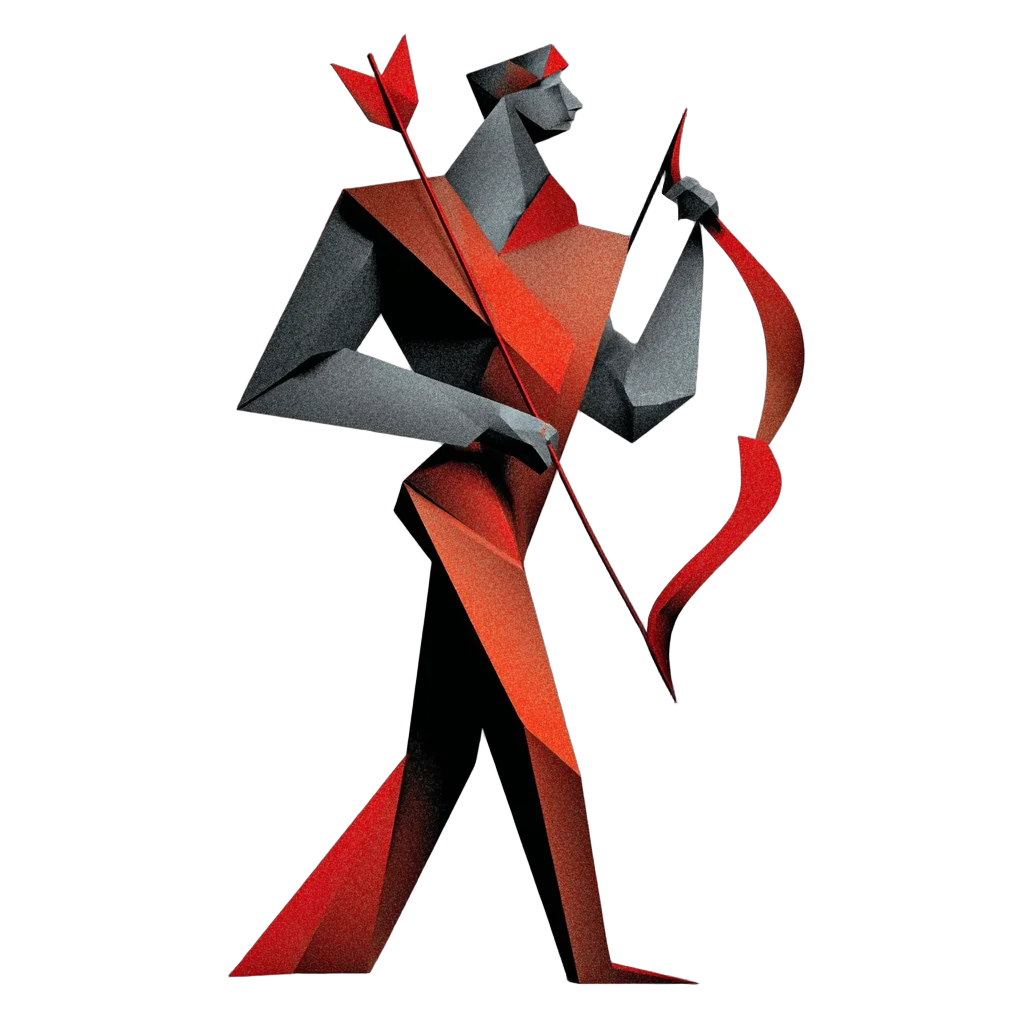
The Combustible Cartographer
A restless mapmaker of possibilities, forever sketching countries that dissolve before the ink has dried.
The Archetype
Where the Sagittarian appetite for the unbounded horizon meets the ENTP's combinatorial intellect, you find a creature who treats reality as a vast, half-finished hypothesis. This person does not merely wish to see the world; they wish to disassemble it, argue with it, and propose three improvements before lunch. The fire of the archer, which seeks meaning through movement, fuses with the Debater's compulsion to test every belief by setting it on fire to see what survives, producing someone whose joy and exhaustion arrive from the same source: the inexhaustibility of ideas.
There is, in this combination, a particular quality of unfinishedness that should not be mistaken for failure. The Sagittarian arrow, once loosed, prefers not to land; the ENTP mind, once engaged, prefers not to conclude. Together they generate a person who lives in the future conditional tense, a tense in which everything is still possible because nothing has yet been required to be true. Companions often experience them as luminous and slightly ungraspable, like weather seen from a moving train.
Core Tension
The deepest fracture in this configuration lies between the Sagittarian hunger for a grand, unifying truth, some philosophy large enough to justify the wandering, and the ENTP's irreverent reflex to deconstruct any such truth the moment it begins to ossify into doctrine. One half of the self builds cathedrals of meaning; the other half cannot resist testing the load-bearing walls with a hammer, and so the cathedrals, however beautiful, are perpetually under renovation and never consecrated.
This produces a quiet, often unspoken loneliness: the person yearns to believe in something with the whole-bodied conviction the fire sign demands, yet the analytical intellect, faithful only to its own restlessness, will not permit the surrender that belief requires. They are pilgrims who cannot kneel.
In Love
In love, this combination courts through provocation and pilgrimage in equal measure. They are drawn to partners who can argue without wounding, who can keep pace through three countries and four philosophical reversals before breakfast, and who understand that intimacy here is not the closing of distance but the shared appetite for further distance. Affection arrives as a question, a challenge, a sudden plane ticket; routine affection, the dependable warmth of repetition, often feels to them like a slow asphyxiation they cannot quite admit they fear.
They love best when they are permitted to remain partially unknowable, and they are loved best by those who recognise that the wandering is not a flight from the beloved but the very shape of their devotion. Still, the tragedy embedded here is real: the same restlessness that makes them magnetic also makes constancy a discipline rather than an instinct, and the partners who stay are those who have made peace with loving a moving object.
At Work
Professionally, this person flourishes in the early, chaotic stages of a venture, where the territory is unmapped and the rules are still being invented; they wither in the late stages, where execution demands the patient repetition of what has already been proven. They need work that permits intellectual sprawl, contact with unfamiliar disciplines, and the freedom to follow tangents that may or may not return with treasure. Bureaucracy is, to them, a form of slow drowning.
The conditions they require are not luxuries but oxygen: autonomy, variety, and colleagues willing to be argued with rather than agreed with. Without these, the Sagittarian optimism curdles into cynicism and the ENTP inventiveness collapses into provocation for its own sake, leaving behind brilliant fragments that no one, including themselves, can assemble into anything that endures.
Communication
Their speech is centrifugal, spinning outward through analogies, counterfactuals, and sudden philosophical detours that may or may not loop back to the original point. They speak to think, not to conclude, and listeners often find themselves participating in something closer to weather than conversation, exhilarating while it lasts, difficult to summarise afterward. They are generous with ideas, blunt with assessments, and frequently unaware of how much heat their casual provocations carry.
What others experience, depending on temperament, is either a long-awaited liberation from polite circling or a faintly vertiginous sense of being argued with by someone who has not noticed they have started arguing. The Sagittarian frankness sharpens the ENTP's already considerable willingness to say the unsayable, and so they wound sometimes without intending to, and apologise less often than they should, because the next idea is already pulling them forward.
Under Pressure
Under stress, this combination does not collapse inward; it scatters. Faced with constraint, grief, or the slow accumulation of obligations that cannot be argued away, they will generate escape velocities of every kind: new projects, new geographies, new theories about why the current crisis is actually an opportunity in disguise. The motion is real, but it is also a refusal, a way of outrunning the interior weather they have not yet agreed to inhabit.
When the running stops, what surfaces is often a sharp, surprising despair, the recognition that the inexhaustible horizon has its own kind of poverty, that one cannot drink from every river and still know what water tastes like. They are unaccustomed to stillness as a tool, and so the first encounters with it feel less like rest and more like exposure.
Growth Edge
The growth direction here is not, as well-meaning advisors often suggest, to become more disciplined or more focused, as if the restlessness were a defect rather than a structural feature. The actual edge is subtler and more demanding: to learn that depth is itself a form of exploration, that staying with a single question, a single person, a single craft long enough for it to disclose its hidden countries is not a betrayal of the wandering but its maturation.
This means tolerating the particular boredom that precedes mastery, the particular vulnerability that precedes intimacy, and the particular silence that precedes meaning. None of these will feel like the horizon they were built to chase, and yet, if they can bear the strange grief of choosing one country and remaining in it long enough to learn its weather, they may discover that the inexhaustible was always vertical, not horizontal, and that they have been skimming a sea that asked to be entered.