sagittarius/INTP
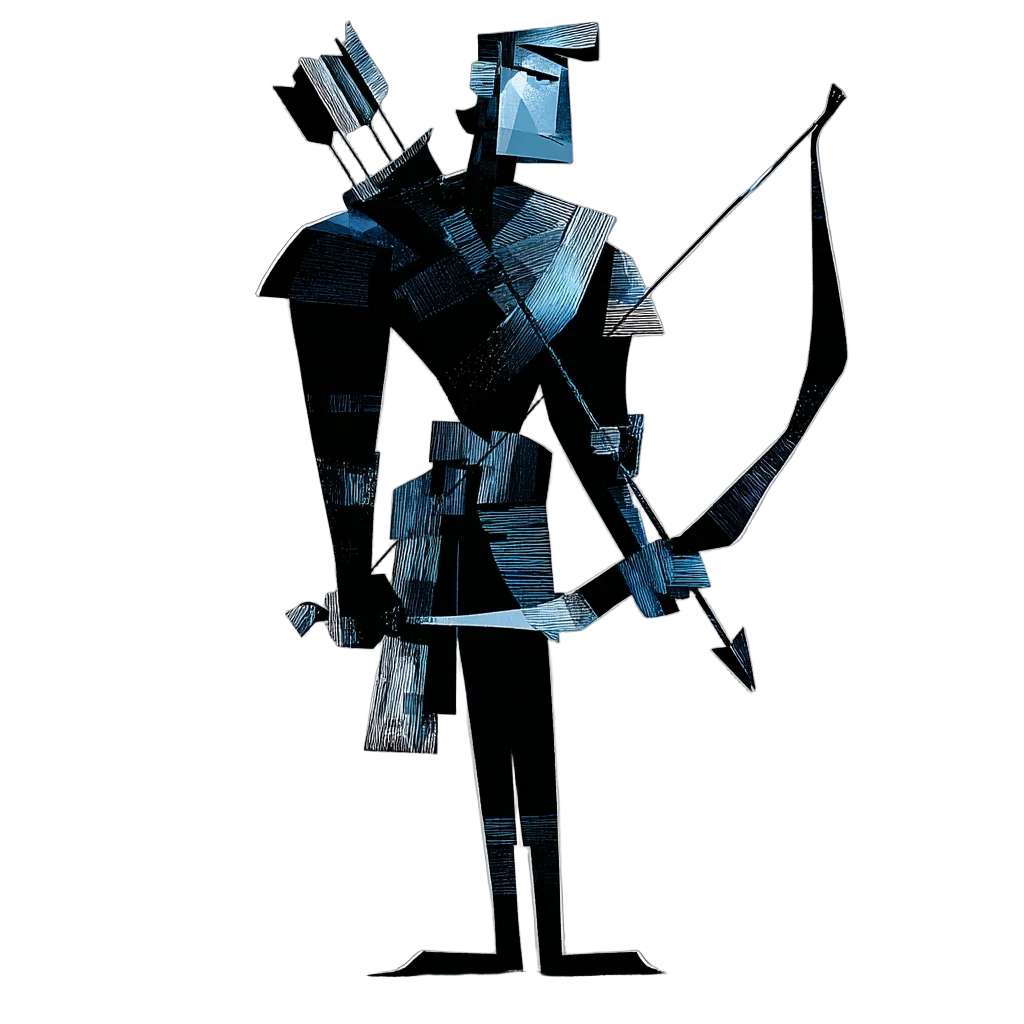
The Untethered Cartographer
A mind that maps infinities it has no intention of inhabiting, restless in theory as in flesh.
The Archetype
To be born under the centaur's arrow and inherit the architecture of the INTP is to live as a perpetual reconnaissance mission into territories that recede the moment they are surveyed. The Sagittarian appetite for the horizon, that almost religious conviction that meaning waits somewhere just past the next ridge, finds in the INTP's analytical interior a strange and incompatible ally: the explorer who would rather draw the map than walk the road, the seeker who suspects that the seeking itself may be the only honest object of the search. This person moves through the world with the dual citizenship of one who believes in grand truths and simultaneously dismantles them for parts.
There is, in this combination, a peculiar lightness that should not be mistaken for shallowness. The fire of Sagittarius keeps the INTP's habitual cognitive labyrinth from collapsing into pure recursion, while the INTP's skepticism prevents the Sagittarian from succumbing to the easy gospels and borrowed certainties that lesser fire signs adopt as decor. What remains is a creature half-philosopher, half-vagrant, equally suspicious of dogma and despair, fluent in the language of possibility but quietly aware that possibility, examined too closely, dissolves into the same grey weather as everything else.
Core Tension
The Sagittarian engine demands motion, encounter, the next country and the next conviction, while the INTP machinery insists on stillness, abstraction, and the suspicion that most movement is merely displacement dressed up as progress. One half wants to throw itself bodily at experience; the other wants to retreat into the cool architecture of thought and decide, from a safe altitude, whether experience is worth the trouble. These impulses rarely negotiate; they alternate, leaving behind a trail of half-finished journeys and half-abandoned theories.
The deeper friction is temporal. Sagittarius lives in the future tense, in the not-yet, the about-to-arrive, while the INTP lives in a kind of suspended present where time bends to accommodate the problem at hand. The result is a person frequently late to their own life, perpetually one revision away from beginning, mistaking the elegance of the plan for the substance of the act.
In Love
In intimacy, this combination courts contradiction with a kind of doomed sincerity. The Sagittarian wants a companion for the open road, someone willing to mistake restlessness for romance, while the INTP wants an interlocutor, a mind that can be turned over slowly in the lamplight of late conversation. Lovers often arrive expecting one and discover the other, and the discovery is rarely comfortable for anyone involved. Affection is real but oblique, expressed in obscure references, in invitations to think alongside rather than in the conventional vocabularies of devotion.
What such a person needs, and what they almost never explicitly ask for, is a partner patient enough to tolerate long absences of the kind that occur even when the body remains in the room. They love by sharing the inside of their thinking, which feels, to the right person, like being trusted with a hidden country, and to the wrong person, like being held at a polite, philosophical distance from anything that might be called a heart.
At Work
Conventional employment fits this combination the way a suit fits a wild animal: technically possible, photographically amusing, structurally absurd. The Sagittarian-INTP requires work that resembles an open question rather than a closed assignment, intellectual terrain rather than procedural ground. They thrive in research, in writing, in the speculative disciplines, in any field where the question is bigger than the deliverable and where curiosity is permitted to wander before it is required to conclude.
They need autonomy that approaches solitude, deadlines loose enough to breathe in, and colleagues who understand that long stretches of apparent idleness are, in fact, the most productive phase of their process. Micromanagement will not merely irritate this person; it will hollow them out, because the part of them that does the real work is the part that requires unsupervised wilderness to operate.
Communication
Speech, for this combination, is a kind of improvisational cartography, sentences extending toward conclusions the speaker has not yet reached, digressions that turn out to be the actual point, theories advanced with the casual confidence of someone who reserves the right to abandon them mid-paragraph. Others often find the experience exhilarating and disorienting in roughly equal measure, leaving conversations unsure whether they have been enlightened, entertained, or quietly dissected.
The tactlessness is real but rarely cruel. They will tell you the uncomfortable truth not because they wish to wound but because the alternative, the small social lie, strikes them as a kind of intellectual cowardice. To be heard by this person is to be taken seriously in a way that occasionally feels like surgery; to be misunderstood by them is to discover that they have, with great precision, missed a point you did not realize you were making.
Under Pressure
Pressure does not produce in this combination the dramatic collapse of more theatrical temperaments; it produces, instead, a quiet evaporation. The Sagittarian fire turns to smoke, the INTP analysis turns to paralysis, and what remains is a person physically present and existentially elsewhere, ghosting their own life with apologetic precision. They will disappear into research, into travel, into elaborate side projects, into anything that resembles motion without requiring commitment.
When the pressure is severe enough, the characteristic optimism of Sagittarius curdles into a particularly arid nihilism, the suspicion that none of the maps lead anywhere because there is no terrain underneath them. This is not depression in the clinical sense so much as a vertiginous clarity that the person knows, from experience, will eventually pass, though knowing this does not noticeably accelerate its passing.
Growth Edge
The work of a lifetime, for this combination, is the patient labor of finishing things. Not because finishing is morally superior to beginning, but because the unfinished accumulates a weight of its own, a sediment of abandoned futures that eventually becomes indistinguishable from regret. The horizon will always offer another, more interesting question; the discipline is to stay with the present one long enough to discover what it actually contains, rather than what its surface promised.
The deeper growth lies in learning that depth and breadth are not opposites to be balanced but practices to be alternated with intention. The Sagittarian-INTP will not become someone else, and should not try; the task is to become this person more deliberately, choosing the wanderings rather than merely suffering them, and accepting that some maps are worth completing even when the territory turns out to be smaller, and stranger, and more final than the imagination had hoped.